Immersed Bridge
Distance: 13.28 Km
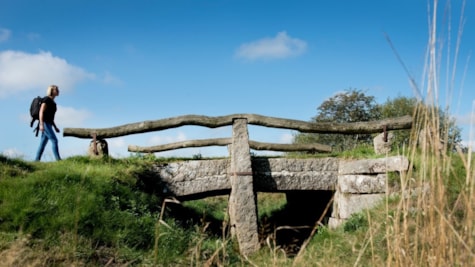
The characteristic Immervad Bridge has allowed travelers to cross the river since 1786.
Updated by: Destination Southern Jutland - VisitHaderslev | bureau@visithaderslev.dk
The bridge is built of split boulders; it was probably previously a wooden bridge, but the name Immervad suggests that the place was used as a ford before the bridges were built. Today, the old ford has been drained, and the stream follows new courses.
The granite blocks for the bridge were carved from one large granite stone. You can see how some of the carved blocks lie exactly on top of each other, as if they were taken from the giant stone. The new, sturdy stone bridge meant that it became significantly easier for cattle drivers to travel with their cattle from Denmark to the markets in Hamburg and Rendsburg. On an average day, between 700 and 800 oxen passed over the bridge.
Fords and bridges have always been gathering places for travelers, and that is why there was also an inn here. Immervad Kro was known for its yellow peas and pork. Today the inn is closed, but there is a rest area and a modern farm, where you can also find one of the many hostels on the military road.
Updated by: Destination Southern Jutland - VisitHaderslev | bureau@visithaderslev.dk
 Photographer: VisitHaderslev Copyright: The highway secretariat
 Photographer: The Military Secretariat Copyright: VisitHaderslev